
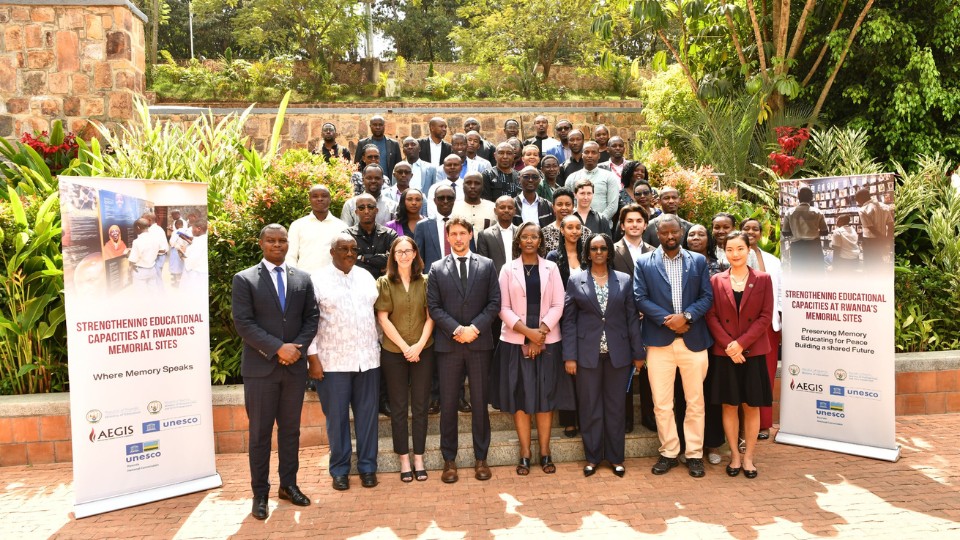
On 9 June, the project ‘Strengthening Educational Capacities at Rwanda’s Memorial Sites’ was launched by UNESCO in partnership with the Aegis Trust, the Ministry of Education (MINEDUC), the Ministry of National Unity and Civic Engagement (MINUBUMWE), and the Rwanda National Commission for UNESCO (CNRU) during a high-level event held at the Kigali Genocide Memorial.
The initiative seeks to enhance the educational role of Rwanda’s memorial sites by equipping educators, developing trauma-informed learning resources, and strengthening collaboration between memorials, schools and communities.
Launched during Kwibuka32, this year’s 100-day commemoration period for the 1994 Genocide against the Tutsi, the project aims to preserve memory while promoting peace, critical thinking and responsible citizenship.
Memorial Sites as Living Classrooms
Opening the event, Aegis CEO Freddy Mutanguha emphasized that remembrance and education must go hand in hand. “Memory tells us what happened; education helps us understand why it happened and what we must do to prevent it from happening again.” He highlighted that Rwanda’s memorial sites are not only places of remembrance but also “living classrooms” where difficult histories can foster empathy, resilience, dialogue and active citizenship among young people.
Education at the Heart of Prevention
UNESCO Specialist on Hate Speech and Genocide Prevention, Karel Fracapane, stressed that genocide can be prevented, and that memorial sites must continue to serve as living spaces of learning, remembrance and intergenerational dialogue.
Speaking on behalf of the Rwanda National Commission for UNESCO, Albert Mutesa highlighted the significance of UNESCO’s recognition of Rwandan memorial sites, noting that they offer invaluable lessons for peace education and should continue to inspire learning that promotes peace, prevention and shared understanding across generations.
Veneranda Ingabire, Executive Director of Memory and Genocide Prevention at MINUBUMWE, emphasized that “We must ensure that memorial sites continue to educate future generations and convey the truth, so that atrocities such as genocide are never repeated in Rwanda.” She noted the project’s impact will extend beyond memorial sites by contributing to lasting peace and responsible citizenship.
Representing MINEDUC, Rose Baguma, Head of the Education Policy Department, said: “Memorial sites are not only places of remembrance. They are powerful spaces for learning, reflection and transformation—spaces that strengthen our identity, inspire active peacebuilding and cultivate promoters of humanity.”
Building Capacity Through Partnerships
The project will strengthen local capacity through Training of Trainers (ToT), mentorship, and ongoing support for memorial site practitioners. It will also develop accessible educational resources in English, French and Kinyarwanda, available in both print and digital formats.
Partners emphasized that documenting lessons learned and addressing challenges such as genocide education and intergenerational trauma will contribute to future educational and remembrance initiatives.
Panel Discussion: Where Memory Speaks – How Memorial Sites Shape Education
A panel discussion explored how memorial sites can strengthen learning and shape future generations.
Eric Muhaturukundo, Manager of Nyamata Genocide Memorial, highlighted the unique educational value of memorial visits: “Through guided visits, dialogue, and engagement with historical artifacts, learners gain a deeper and more impactful understanding than textbooks alone can offer.”
Assumpta Mugiraneza, Director of IRIBA Centre for Multimedia Heritage, said: “Memorials are not places to simply observe, but spaces to seek understanding and construct meaning from complex history.” She emphasized that meaningful engagement requires guided learning, archiving, digitization, and educational approaches that foster reflection while actively deconstructing ideologies of hate.
Youth leader Tristan, reflecting on his own first visit to the Kigali Genocide Memorial, spoke to the emotional complexities many young people face and the need for dialogue, preparation and safe spaces: “Memory work is not just about visiting sites, but about understanding the past responsibly and building a more thoughtful future.”
Kayitare Frank reinforced the role of memorials as spaces for peacebuilding and critical reflection: “Memorials are not one-sided narratives, but vital spaces for peacebuilding and education. They preserve not only the consequences of violence, but also the warning signs and societal conditions that preceded it.” He noted that memorials can facilitate difficult but necessary conversations within families and communities while strengthening social cohesion.
Looking Ahead
Following the formal launch, a technical workshop was convened to inform the development of educational materials. Implemented by the Aegis Trust in partnership with MINEDUC and MINUBUMWE, the consultation marked a key step in the design and validation process to ensure the materials are pedagogically sound, contextually relevant and aligned with national education priorities.
The Aegis Trust presented draft materials, including a teacher guide, student resources and a facilitation manual. Participants engaged in structured discussions on pedagogical alignment, age appropriateness, trauma-informed approaches, adaptability across memorial sites, and strengthened linkages between formal, informal and non-formal education. The feedback gathered will guide refinement and piloting, strengthening usability and stakeholder ownership across education and memorial contexts.